🗣️ What makes a good conversation?
What makes a conversation successful? What makes a conversation with a person with aphasia successful?
I posed this question to Anthropic’s Claude, to try to tease out what kinds of features would be most helpful in supporting listener-oriented conversation. For the most part, I agree with this perspective:
A successful conversation generally involves a few core elements:
Mutual understanding — both people feel they've been heard and comprehended, even if they disagree.
Turn-taking and reciprocity — the exchange flows naturally, with each person having space to contribute.
Shared purpose — whether it's exchanging information, building connection, solving a problem, or simply enjoying each other's company, both parties are oriented toward something together.
Responsiveness — each person reacts to what the other actually said, not just waiting for their own turn to speak.
Repair — when misunderstandings happen (and they always do), both people work together to clear them up without significant friction.
Psychological safety — people feel free to express themselves without fear of judgment or ridicule.
Success doesn't require eloquence or equal contribution — it requires that both people leave feeling the exchange was worthwhile.
When I think about conversations with my mom, there’s so much she wants to say. She is always one to weigh in, provide reassurance, or give a witty retort. She has a terrific sense of humor. None of the AAC solutions today enable her to relate to people how she used to.
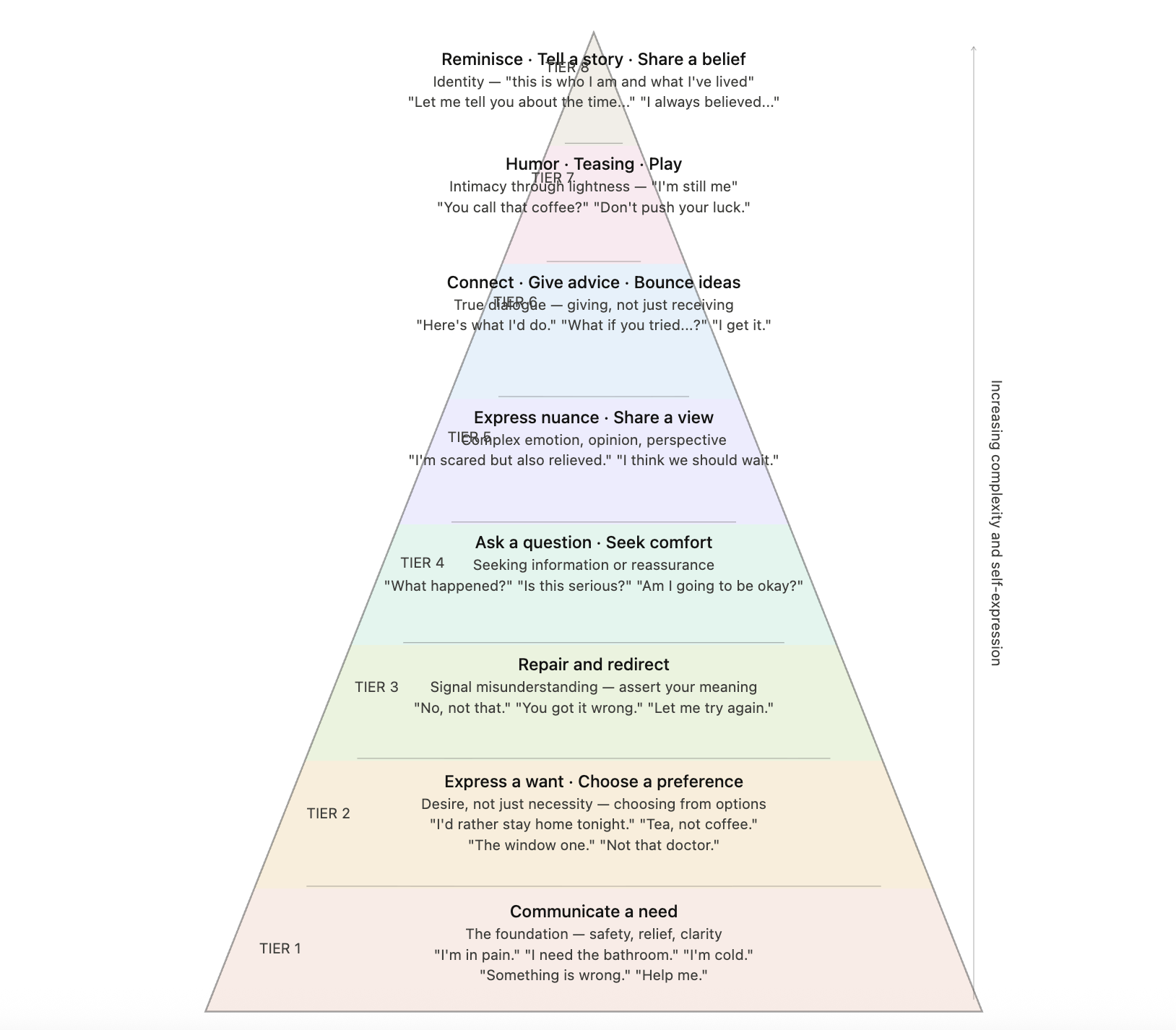
I generated a visualization of this need as a pyramid, where the most nuanced elements of a successful conversation are featured at the top. At Broca, this is where we’re focused next.